
≡ Menu

dougmcclure.net

thoughts on business, service and technology operations and management in the digital transformation era

Interesting Links for September 9th

in General

Links that I have found interesting for September 9th:

  • OpTier Unveils CoreFirst 3.0; Delivers True End-to-End Business Transaction Management – In the Forrester Research, Inc. report titled "Business Service Management Market Update" issued on July 3, 2008 by Peter O'Neill, the analyst states, "It has become clear that IT has been too preoccupied with its own processes in the past — even calling them services — and it must now pay more attention to the performance of the business services that it ultimately supports with technology."

    CoreFirst 3.0 is the only product to offer automatic, continuous discovery of the links between business services and IT components without any manual modeling or mapping. This enables organizations to track and monitor transactions upon installation. Because CoreFirst does this automatically, it also identifies and reacts to changes in the infrastructure in real-tim

  • CA, IBM First to Demonstrate CMDB Federation, Interoperability – CA, Inc. (NASDAQ: CA) and IBM (NYSE: IBM) today announced the ability to share information between their respective configuration management databases (CMDBs) and management data repositories (MDRs), such as asset management systems and service desk solutions. The interoperability demonstration, based on the CMDB Federation (CMDBf) specification and debuting this week at itSMF Fusion ’08 in San Francisco, gives customers a way to better consolidate IT data in a multi-vendor environment by linking CA and IBM data sources for a single view of their IT systems and components, and the relationships among them.
  • Netuitive Adds "Intelligence Layer" for IBM Tivoli – Netuitive, the leading provider of self-learning performance management software, announced today an advanced integration with IBM Tivoli Management. With this solution, customers can automatically correlate IBM Tivoli performance data with monitoring data from third-party tools such as BMC Patrol, Microsoft Operations Manager, NetIQ, VMware, HP Openview Operations and Sitescope.
  • Managed Objects Advances Web 2.0 Strategy – Managed Objects, the Business Service Management (BSM) Company, today announced the release of Web 2.0 Connect, a new tool that provides developers of Rich Internet Applications (RIAs) access to data within Managed Objects’ products for applications they build. Developers can use this platform-independent API to access the Managed Objects’ data model and analytics to bring information into their own applications, which can range from Web-hosted applications to clients for portable devices to standalone desktop programs.
0 comments

Looks like I’ll put off talking about a more pleasing subject of the importance of events for TBSM v4.2 to talk about something I’ve been thinking, playing, struggling with this past week. More details will have to wait until we’re GA here in a few weeks, sorry.

I can’t stress enough that you begin to create a thorough design and implementation plan for how you’ll establish access, authorization and authentication (AAA) within your TBSM v4.2 solution. Things have SIGNIFICANTLY changed in TBSM v4.2. There are many different options and settings throughout the product that must be set to implemented in a typical production environment. Many of them are easy to overlook, trust me!

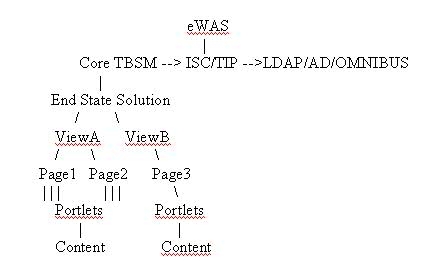
I recommend starting with a systematic assessment of your existing environment (or strawman of what you think your requirements will be). If my end solution is a TBSM v4.2 layout with numerous views, pages and portlets, navigation and launch in context attributes, you must think through all of these components and document what users, roles or groups can access, see and do things. Are these users authenticated in an external source? What group are they assigned at login? Do they have the correct roles assigned to perform your expected tasks?

From an administrators perspective, you’ll need to think through things in the same manner, ensuring that you can perform the administrative tasks – and have the proper configurations to perform work as if you were a member of the end user group. This is a CRITICAL component, especially when implementing custom canvas dashboard solutions for users/groups.

I have this visual in my head of what this may look like to capture how things may be designed:

At each level, I envision documenting all of the critical configurations and settings with heavy focus on who can access, what can they do/see/click-on, etc. Trust me, there are configuration options at every level that you need to think through. This is especially true if you’re implementing solutions where one user/group can see some things and can’t see others.

Some random thoughts to consider as you work through this stuff:

  • Are you using an external source such as LDAP, Active Directory or Netcool/OMNIbus for authentication and authorization? How will you integrate? What will the information exchange be? Do you know what your LDAP/AD group needs from you for configuration?
  • Will you take advantage of the new Single Sign On (SSO) capability? How? What products will you want SSO access to from TBSMv4.2 / TIP?
  • If you’re using legacy TBSM v3.1, Netcool/RAD or TBSM v4.1.x today, start to really look at what you’re doing and how your end user audiences access and work within this environment.
  • What types of users do you have? Read only, have some privileges, superusers, etc.? What PSML, pages, tabs, view points can they see/access?
  • What roles do they have today in each respective product? What can they do? What can they see? What menus, options, dialog boxes, check boxes, etc. can they interact with?
  • Are you assigning roles to users or roles to groups or both? How should you be assigning roles for effective management? How would you audit this if asked?
  • What groups do you have? What roles are assigned to groups?
  • What NGF security models have you implemented? Are you controlling access to certain PSMLs, viewpoints, etc?
  • Will you allow users to manage events from within TBSM? What permissions will you require from an event management perspective from Netcool/OMNIbus or Netcool/Webtop?
  • What Tivoli Common Reporting (TCR) reports or charts will you incorporate into your solution? Will your users be able to design/upload their own?
  • If launching out into other products, what AAA is required to allow that user to perform expected tasks, actions, etc. in the remote product (TEPS, ITM, TADDM, TSRM, etc.)
  • Do you have additional security requirements such as SSL? Do you use CA Signed Certs or Self Signed Certs? Where do you require communications to be encrypted? (User to GUI, TBSM–>LDAP/AD, TBSM–>Other Product) There’s a GUI for this stuff now so hopefully no more command line and file hacking is required.
  • You’ll want to learn as much as possible on this repository concept. (standalone, federated, etc.) More than likely you’ll be digging into WebSphere manuals if you have any significant security requirements. It appears as if you’ll always be in this federated repository mode using a local file and other source.

Shameless plug

IBM Tivoli Services and our TBSM AAA Accredited Business Partners are always available to help advise and consult with you in these areas. Please do not hesitate to contact me at anytime and I can help arrange further discussions.

1 comment

Interesting Links for September 4th

in General

Links that I have found interesting for September 4th:

  • N(i)² – N(i)² provides software solutions designed to improve visibility and control over the increasingly complex IT infrastructures that businesses rely on for effective and profitable operations.

    By consolidating and sharing knowledge across organizational silos – and by adding certainty to change management processes – N(i)² solutions enable improved resource optimization, more dependable business continuity and enhanced IT governance practices.

    * Resource Optimization
    Our technology enables you to maintain a repository of detailed infrastructure configurations, assembled from every silo in the IT organization. This single version of the truth enables you to be aware of the IT resources that are over- or under-utilized, and those that are not used at all.

    * Risk Mitigation to drive Business Continuity
    * Governance

  • BlueStripe Software – Application Service Management for VMware Server Platforms Process-level Service Discovery, Management, and Problem Triage

    Application Owners and VMware Administrators agree that business application availability is the most important objective. The challenge is to provide the necessary application management visibility while embracing the flexibility of the new virtual platforms and the existing real hardware platforms.

    BlueStripe is the only management company that allows VMware Adminstrators and Application Administrators to perform:

    * Application Discovery & Mapping
    * Application-level Health & Performance
    * Automatic Triage of application & server problems

    Whether in QA, staging, or at deployment time, BlueStripe gives you complete visibility to applications running on virtual and physical servers to understand where your applications are running, their dependencies, and how well they are running.

0 comments